
By Marie-Line Lormans
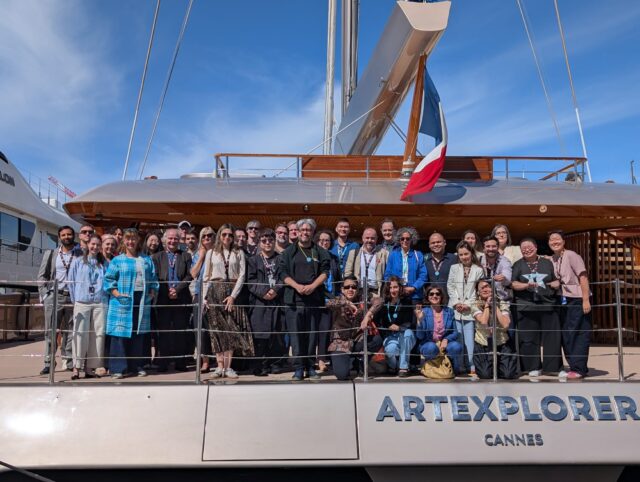
On Thursday 14 May, Europa Distribution, the international network of independent film publishers and distributors, joined forces with the Asian Film Alliance Network (AFAN), Conferencia de Autoridades Audiovisuales y Cinematográficas de Iberoamérica (CAACI) and European Film Agencies Directors association (EFAD) to bring their members together. The event, organised in partnership with the Marché du film de Cannes, welcomed 16 independent film distributors and 22 film agencies representatives from the four organisations, on the Art Explora Boat in Cannes. This first-time working session was designed to make distributors and film agencies engage in a positive and constructive dialogue, with the ultimate goal of identifying ideas and best practices, to strengthen the international circulation of films, connect them with audiences beyond national borders and ultimately foster cultural diversity.
Participants from markets ranging from Europe, Asia, Central and South America to Australia and Canada, discussed for 90 minutes how to better support a diverse film offer on all screens, ensuring access and better visibility to wider audiences. At the end of the workshop, participants shared the main conclusions that had emerged during the discussions, highlighting common challenges from audience development and funding structures to political advocacy and cross-border collaboration.
One of the main takeaways shared by the participants was that despite operating in national markets that differ greatly from one another, most challenges are shared across the world. For this reason, sharing best practices and working on enhancing international collaboration to strengthen the sector is an essential first step, the participants emphasized.
Offering cultural diversity was identified as the key motivation for international circulation, helping audiences discover a wider range of stories from around the world. National and regional support mechanisms play a critical role in ensuring that films beyond the commercial mainstream remain visible and accessible.
Participants also reflected on the wide variation in market realities across participating countries. In some, support covers the entire value chain from production through distribution. In others, funding is concentrated almost entirely at the production stage, leaving distribution structurally underfunded. The discussion then turned more practical, with participants focusing on the logistics and accessibility of distribution support when in place. Two main distinct types of support were identified: the first is the support provided to national distributors who distribute non-national films in their home market; the second one is the support offered by a national fund to foreign distributors who distribute a film originating from that country, an outward-facing mechanism designed to extend the reach of national cinema abroad. Both are considered indispensable for the international circulation of films and ideally complement each other. Norway was highlighted as a successful model for combining both types of international distribution support, funding national cinema abroad while also supporting distributors of foreign films domestically through the Norwegian Film Institute.
On the other hand, Australia and Colombia, for instance, each contend with national film market shares of around 3–5%. Hence their primary focus is on building domestic audiences for local productions. In that context, the ambition to support national works on a global scale can feel distant. When a film struggles to find its audience at home, international reach may be a secondary concern.
One important consideration was that effective film distribution does not begin with the release. Distribution strategy needs to be integrated into the production process from the beginning, well before a film is complete. Producers who consider audience targeting early on are better positioned to align funding, marketing, and acquisition strategies accordingly, as having a clear plan from the start avoids resource misallocation and missed opportunities.
Another emerging topic was the need for more communication through the value chain, from film agencies to distributors on existing supports: sometimes, distributors are not informed of the existing schemes, which leads to under exploitation of resources specifically designed to help them. In this context, the workshop became the space for knowledge-sharing for professionals from different countries.
In fact, clarity around funding criteria is essential for distributors. Knowing which support mechanisms are available in a given country, and under what conditions, can directly influence acquisition decisions: a distributor who can assess likely support early in the process is a distributor who can commit to a film with more confidence.
The importance of direct access of distributors to funding schemes instead of reliance on other parties was highlighted as well. The ability to apply independently and to plan the release strategy based on what works in their specific market, is very beneficial for effective distribution planning. Ideally, funding confirmation would come before a film’s release, as this allows marketing and distribution spend to be planned more effectively. In this instance, the Swiss funding model arose as a good example as it enables distributors to apply for support independently.
Furthermore, there was a call for administrative simplification. Some complex time-consuming application processes can be a barrier, particularly for smaller distribution companies.
Cinema attendance remains a key challenge across markets, with subscription models being highlighted as one of the most effective tools currently available to address it. By offering audiences more affordable and flexible access to cinema through cards or subscription initiatives, distributors and exhibitors can increase the frequency of visits and, crucially, expose viewers to films they might not otherwise have sought out, notably international titles that tend to lose out to mainstream blockbusters in traditional single-ticket purchasing.
Youth engagement was also mentioned as a long-term investment that several participants felt had been overlooked. Educational programmes targeting young audiences offering discounted access to culture, such as France’s passe culture, were presented as fundamental infrastructure for the industry’s future. When young people are introduced early to a diverse range of films, their habits and expectations shift, transforming cinema into a space for curiosity and discovery, not just entertainment.
The session also explored the impact of the current political environment in which the industry operates. Economic pressure and geopolitical instability complicate the defense of soft power and cultural funding. And yet, as several participants noted, these are precisely the conditions that make the case for cinema’s role as a tool for soft power, cultural exchange, and international understanding most compelling.
Perhaps what stood out most from the session was the quality of worldwide cross-border exchange that was made possible: the Marché du Film is one of the few places where the entire sector gathers in one place, but it is also one of the busiest periods in the year. Despite this challenge, the 40 professionals took time to participate in this important conversation.
The insights gathered around audience development, strategic distribution planning, funding structures, political advocacy, and cross-border learning, reflecting the sector’s collective goal to share knowledge more systematically, to simplify access to support, and to keep building the infrastructure that independent cinema depends upon.
A second working session is already being considered, a sign that the conversation started in Cannes is intended to continue.