
By Valentina Serra
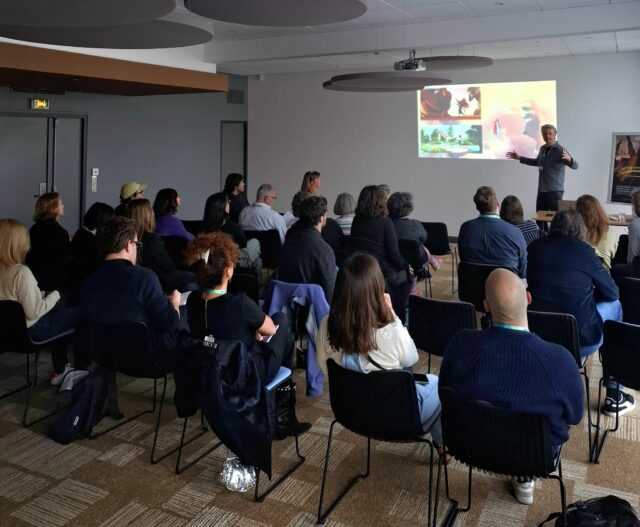
This March, Europa Distribution reaffirmed its collaboration with Cartoon Movie, a partnership that has been ongoing for over fifteen years. They hosted the recurring case study workshop on animation distribution at the 28th edition of the European animation co-production and pitching event, which took place in Bordeaux between 3 and 6 March 2026. During the workshop, close to 35 film distributors from all over the world attended a closed session in which five industry professionals shared case studies on recent animated film releases. The session was designed to facilitate the exchange of insights and practical strategies, particularly regarding audience engagement, marketing approaches, and new promotional methods for positioning European animated films within markets that are increasingly competitive, especially on this segment.
Vanessa Ciszewski, founder of Luftkind Filmverleih in Germany, opened the session by discussing the release of Animal Tales of Christmas Magic, an animated project that the distribution company also co-produced.
Since Luftkind Filmverleih was a relatively new company at the time of the co-production, they had to invest heavily on promotion and marketing from the very beginning. For example, in Germany the title was directly changed to “Weihnachten der Tiere”, which loosely translates to “Animal’s Christmas”, to sound more appealing to the German audience and reflect the festive and animal-centered storytelling approach. The film is co-directed by six emerging female filmmakers from around the world and consists of five visually distinct chapters connected through a shared narrative theme. To emphasize this peculiar structure, the marketing team created individual visual identities for each story, highlighting the diversity of the narrative segments. They also created a modular, question-based campaign designed to engage different audience groups. The communication strategy revolved around five reasons to watch the film, extending the modular campaign alongside trailers, behind-the-scenes content, special preview screenings, and merchandising.
The digital campaign was particularly strong and included collaborations with “mom influencers”, proving once again the importance to target parents as well as children. The key question guiding the strategy was: “How do we appeal to little kids and convince families to take them to the cinema?”. The campaign was successful: positioning the film as “the perfect film for a first cinema visit”, combined with the Christmas theme, proved highly effective.
The second presentation of the day was given by Adeline Margueron, responsible for distribution at Le Parc Distribution, part of the cultural centre “Les Grignoux” in Belgium. The case study focused on the release of Hola Frida, a film by Karine Vézina and André Kadi, released in the French speaking part of Belgium on July 2, 2025. Since the production was in French, the Belgian distributor relied heavily on promotional materials provided by the French company Haut et Court, which had distributed the movie in France earlier that year. Despite the fact that they used existing materials, the Belgian distributor efficiently adapted the communication strategy to their own territory, while maintaining visual coherence with the film’s original campaign.
The campaign included partnerships with Auvio Kids TV and Le Ligueur Magazine, but one of the most distinctive elements of the marketing strategy was engaging disability communities directly. Le Parc Distribution developed a partnership with EOP!, the association that organizes the Extraordinary Film Festival, making accessibility a central topic for the release. The Distributor also provided Hearing Impaired and Visual Impaired versions of the film and organized several HI-VI screenings in different theatres. The film benefited from participation in the educational program Écran Large sur Tableau Noir, which connects cinema distribution with schools and cinemas. Within this framework, school matinées were described as the “secret ingredient” of the release strategy by Margueron.
Next, Richard Reiter, film distributor at Filmladen Filmverleih in Austria, shared the release strategy for Tafiti – Across the Desert by Nina Wels. The film was released on September 4, 2025, coinciding with the first week of school in Austria after the summer break, as its summer theme well suited the period.
The release strategy relied on traditional prints and advertising, ensuring strong visibility for the film both in cinemas and in public spaces. A particularly original element of the campaign was a major partnership with the sunscreen brand Solero, which enabled a large cross-promotional campaign while sharing costs and giving the film extra visibility. Through this collaboration, advertisements were placed in outdoor swimming pools, as well as in pharmacies and stores, during all summer. Another original element of the distribution strategy included the organization of numerous special events designed to engage specific communities. One notable example was a screening initiative aimed at the Ukrainian community living in Vienna, as the distributor decided to propose a Ukrainian-language version of the film. Reiter concluded that the release was successful in terms of numbers.
Tafiti – Across the Desert was also distributed by MCF MegaCom Film and the founder of the distribution company, Igor Stanković, shared insights into the release strategy of the film in the Adriatic region, a particularly complex territory to work in, as the release involved five different countries and languages. The film was released in Serbia, Montenegro, Croatia, Bosnia and Herzegovina and North Macedonia with wide release, positioning it as a must-see for family audiences.
The marketing for the film combined online, radio, outdoor and PR channels, creating a multi-platform presence across the region. The company approached the film as if it was a major studio release, investing heavily in the promotional campaign, particularly in high-quality dubbing. They hired Boda Ninković, a well-known actor in the region, to voice one of the characters, using the celebrity’s name as a promotional tool. The goal was to position the film in the market with the same visibility and prestige typically associated with large international animated productions. As Stankovic noted, “if you are not oriented toward children, who are you oriented toward? They are the future of cinema.”
In terms of results, the film achieved solid admissions. However, the distributor also stressed that the investment required for this type of release is considerable, particularly producing five different dubbed versions to cover the linguistic diversity of the region.
Stanković also presented the release strategy for the Oscar-nominated film Arco by Ugo Bienvenue, which had just been released at the time of the presentation, although it had been acquired two years earlier, based on its script. The release strategy for Arco was built around a festival-first positioning, establishing the film as a premium cultural title before expanding into a wide regional release. Festival screenings played a key role in shaping perception, aligning the film with curated programming, educated audiences, and strong media visibility. As a matter of fact, Arco was selected as the opening title of the 21st KidsFest, Serbia’s premier children’s film festival. Moreover, the film also screened at the Festival of Tolerance, a prominent cultural platform held in Zadar.
The last speaker of the workshop was Michal Dvořák from Zero Gravity who also presented their release strategy for Arco, acquired by the Czech distribution company shortly after the Cannes Film Festival 2025. The distributor saw mainstream potential in the film and expected significant media coverage.
The marketing campaign relied heavily on social media, although results varied depending on the platform. For example, on Facebook the campaign encountered a wave of homophobic comments triggered by the presence of rainbow imagery in the film’s visual identity. For this reason, the marketing focused on three main thematic areas: friendship, family and spectacle/adventure. In contrast, TikTok and Instagram proved to be much more effective, reaching younger viewers and generating more positive engagement with the campaign.
Apart for children and their families, Zero Gravity targeted anime communities and adults passionate about animation in general, mainly because of the Ghibli Studio influence on the filmmakers of Arco. The dubbed versions aimed at children ultimately performed better than the screenings targeting animation enthusiasts. Although the distributor had hoped for slightly higher numbers overall, the final outcome was still considered positive.
In conclusion, the case studies presented during the workshop highlighted the complexity and diversity of animation distribution strategies across different European territories. Despite differences in market size, language, and audience structure, several common patterns emerged, particularly the importance of clearly defining target audiences, building strong partnerships, and developing creative marketing strategies tailored to each film’s identity. The examples discussed demonstrated that successful distribution does not rely solely on large budgets, but also on strategic positioning, early marketing planning, community engagement, educational initiatives, and cross-promotional collaborations.
In addition to the workshop activities, members of Europa Distribution also took part in the pitching sessions and networking events organised during Cartoon Movie, using the opportunity to further consolidate their involvement in the animation sector.
ED will continue its role as network and think tank in upcoming key industry events later in the year, such as Focus Asia in Udine, New Nordic Films in Haugesund, The Venice Production Bridge and The San Sebastián International Film Festival. More information can be found on Europa Distribution’s website.