
By Marie-Line Lormans
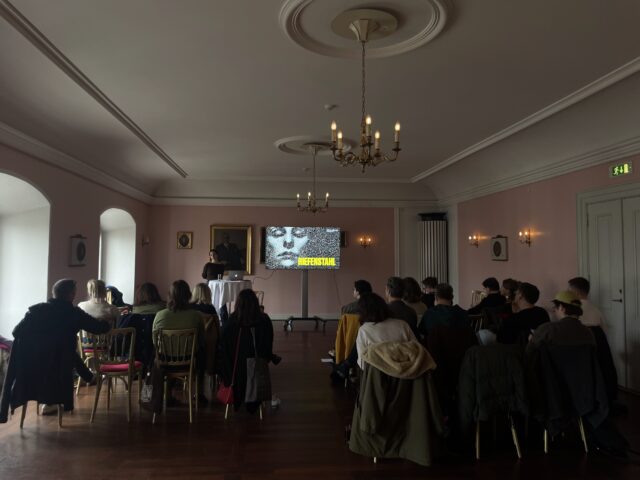
Europa Distribution organized their workshop for film publishers and distributors of the association for the second time in scope of CPH:DOX, the Copenhagen International Documentary Film Festival from March 15–18, 2026. Twenty independent distributors from across the world came together for a closed case study workshop focused on the release and promotion of documentaries, exploring topics such as audience engagement and impact campaigning. Alongside this session, the distributors also attended a working session with sales agents and many industry and networking activities offered through the CPH:DOX Industry Programme.
On Monday morning, the closed workshop opened with a first case study on the film Riefenstahl by Andres Veiel, presented by Sylvie van den Broek, Marketing and Publicity Manager at Imagine Filmdistributie in The Netherlands. Imagine acquired the film after its world premiere at the Venice Film Festival, convinced by the multi-layered portrait of Riefenstahl pieced together from her personal archives. The film was described as both historically grounded and urgently contemporary, with clear parallels to modern debates about propaganda, fake news, and the ethical limits of art and cinema. The Dutch distributor scheduled its theatrical release for 24 April 2025, positioning it just ahead of Memorial Day on 4 May and Liberation Day on 5 May. The IDFA premiere in November 2024, held at Amsterdam’s Tuschinski theatre, served as an ideal launch, as screenings sold out, and Q&As with the director steered audience engagement.
For the marketing campaign, Imagine positioned the film towards their culturally engaged, core arthouse demographic. Rather than a standard double-sided flyer, they produced an extended printed folder providing contextual background on Riefenstahl’s life and work, highlighting why revisiting this topic now matters. The German key art was retained throughout, built around the tagline: “One of the most controversial figures of the 20th century.” For the very first time, Imagine worked with an outreach producer, who contacted an established network across WWII organisations, historical societies, memorial institutions, archives, and film education communities. The outreach producer secured ticket giveaways, placed the extended folders in museums and cultural venues, and initiated events including film-and-conversation evenings focused on archive ethics, propaganda, and the use of images. Several organisations later arranged private screenings months after the official release.
Critical reception was strong, with many positive reviews. The team was broadly satisfied with the results, also considering the fact that spring releases usually have to compete with the early sunny days in the Netherlands.
Droo Padhiar, Head of Marketing and Communication at Dogwoof in the UK, explained that their approach to the same film showed similarities while, at the same time, telling a slightly different story. The UK rights for Riefenstahl were also acquired following the Venice world premiere, where strong responses from the industry highlighted strong audience interests. The initial strategy had been modest: primarily a DVD and home entertainment release, grounded in the reliable UK appetite for WWII history and the purchasing habits of an older audience. Test screenings changed that calculation quickly. The audience response was overwhelming enough to justify a pivot to a proper theatrical release, with home entertainment repositioned as a second phase.
The release was planned around V-Day on May 8, with the intention of being present in national conversations about WWII history and its contemporary resonances while at the same time respecting the anniversary, without exploiting it. The director was unavailable during the initial UK release, committed to supporting the Dutch and Danish openings. In his place, Sandra Maischberger — a German television personality and one of the film’s producers — came over to the UK for Q&As and press engagements. The press response was, by Dogwoof team’s own description, exceptional. Complementing the press strategy was a network of eight institutional partners, including the Goethe Institut, the Holocaust Educational Trust, the Jewish Museum London, the German Screen Studies Network, and the UK Jewish Film Festival. These organisations hosted screenings, retrospectives, and contextual events. The partnership work was considered among the most impactful elements of the campaign.
History-oriented audiences, particularly those aged 55 to 64, proved to be the highest converters, accounting for around 70% of ticket purchases. By the standards of British independent documentary releasing, it was a significant over-performance. The theatrical success unlocked a DVD release approximately two months later, which performed strongly despite the general contraction of the physical media market. VOD, broadcast sales, and ongoing bookings from universities, film clubs, and history networks have continued well beyond the release window.
The next case study presentation was given by Kim Foss, CEO of Camera Film in Denmark together with Susanna Peevo, Office manager at Cinema Mondo in Finland, for their release of Gaucho Gaucho by Michael Dweck and Gregory Kershaw. Their cross-border collaboration didn’t begin with this film, but grew out of a previous collaboration for The Truffle Hunters, which became a remarkable success across the Nordics. That success built trust between the Nordic partners, and when the same directing duo returned with Gaucho Gaucho, taking the film together felt natural.
The Danish team changed the original film poster, adding a mountain into the background to give it more visual drama. This kind of thinking reflects a broader philosophy that the Danish team applies to art house releases: “For the price of 10 to 12 euros, you give the audience an hour and a half in the northeast of Argentina. We are, in a way, travel agents.” Both teams invested in community outreach besides their usual art house audiences, as the strategy for Gaucho Gaucho was to reach fans of The Truffle Hunters, horse enthusiasts and Spanish-speaking communities, including outreach through the Argentinian embassy.
While a festival premiere generates buzz, it can also possibly exhaust a film’s media moment before the theatrical release even begins. The Danish distributor noted that waiting out the festival cycle is often the right call for them, even when it feels risky. In the case of Gaucho Gaucho, the team chose to wait after the CPH:DOX cycle to release— and while the numbers were modest, the consensus was that an earlier release would have resulted worse. The Finnish distributor had another experience: the Helsinki Film Festival hosted the film’s Finnish premiere and brought director Gregory Kershaw to meet press in person. This visit one week before the release proved pivotal as the director shared openly how he spent two years in Argentina to absorb the culture. The resulting press coverage went well beyond standard reviews, with journalists writing in-depth articles about the film’s world. Finland’s numbers for Gaucho Gaucho had the best result in the Nordic region, and likely one of the strongest anywhere. P&A spending was modest, with the budget concentrated almost entirely on social media. A small number of collaborations with an animal welfare advocate and a local cowboy figure helped extend reach into relevant communities. Gaucho Gaucho was described as a film “carefully crafted with the same warmth and folkloric intimacy that made The Truffle Hunters so beloved. Watch it if you have the chance,” the Finnish distributor added. “It’s so beautiful”.
The last presentation of the day was given by Marie Regehr, Head of Acquisitions at Filmladen in Austria, on the release of Das Flüstern der Wälder (Le Chant des Forêts / Whispers in the Woods) by Vincent Munier. Le Chant des Forêts, the latest nature documentary from the director behind The Velvet Queen, was released in Austria on February 13th in its original version with German subtitles, alongside a dubbed version handled by German partner distributor Pandora Films.
Austria has a genuine cultural affinity with forests so it came natural that, for the marketing campaign, the distributor leaned into the famous concept of Waldbaden — forest bathing, the meditative practice of immersing oneself in woodland. Partners included the Federal Forestry Agency, an organic cosmetics brand with a forest-scented product line, the Alpine Club (Alpenverein), a research team from the University of Vienna studying the health benefits of forests, and an institute dedicated to forest bathing. The positioning was the forest as a multisensory cinematic experience, as a space for connection with nature. A kickoff preview event anchored the release week, with partner organisations helping spread the word through their own networks. Social media spending focused on moving imagery: animated posters, character-led assets designed for sharing. Despite the first weekend bringing a solid start, it did not last long. The responsible was, at least in part, an unusually long Austrian winter finally interrupted by the first sunny weather that brought audiences outside, into the nature that they can find in their own country. Le Chant des Forêts may not have been the success the distributor hoped for, but it remains, in her words, a beautiful title in the catalogue.
On Tuesday, at the joint working session hosted by CPH:DOX in partnership with Europa Distribution, film distributors and sales agents gathered to exchange insights on the realities of documentary sales and distribution. Across three roundtable discussions, participants explored what tools and resources would make their work easier. From the immediate need for simple, practical tools (like WhatsApp/Discord groups, shared one-sheets, Zoom calls) that can be implemented without structural change, to longer-term aspiration for better data infrastructure, improved platforms, and collaborative funding mechanisms. The group examined how best practices are currently shared across territories, identifying a clear appetite for more structured communication around releases and honest case-sharing, including failures to learn from. A final discussion on how documentary distribution works practically highlighted the event-driven, outreach-heavy nature of doc campaigns, the deep importance of local context, and the value of plural audience thinking.
During the workshop at CPH:DOX, distributors highlighted the diverse challenges when it comes to documentary releases as they discussed how to handle historically weighty, ethically complex documentary material. From the sessions arose the importance of timing, the director’s presence, and the value of institutional partnerships in extending a film’s reach and longevity in a competitive and fragmented media landscape. From the working session with sales agents, one message rang clear: relationship-building between distributors and sales agents, and the whole value chain, remains essential in the documentary ecosystem.
Europa Distribution will continue its role as network and think tank in upcoming events for a panel on releasing Asian films in Europe at Focus Asia in Udine, and many more events to come in Haugesund, Venice and San Sebastián.